
News You Can Use: News items from external sources that might be useful to MDSR residents.
Echoes of the Peace
Echoes of the Peace: Pioneers, Steam, and Brushstrokes in Beaverlodge
Our next Bus Trip is heading for Beaverlodge & Valhalla this Friday, July 17th where you’ll get to tour the South Peace Centennial Museum and Interpretive Centre, Beaverlodge Art & Culture Centre, and Euphemia McNaught Homestead Heritage Site. Together, these three places form a rich tapestry of heritage in the Beaverlodge area of Alberta’s Peace River Country. These sites preserve the region’s pioneer agricultural roots, early settlement architecture, and vibrant artistic legacy.
South Peace Centennial Museum and Interpretive Centre
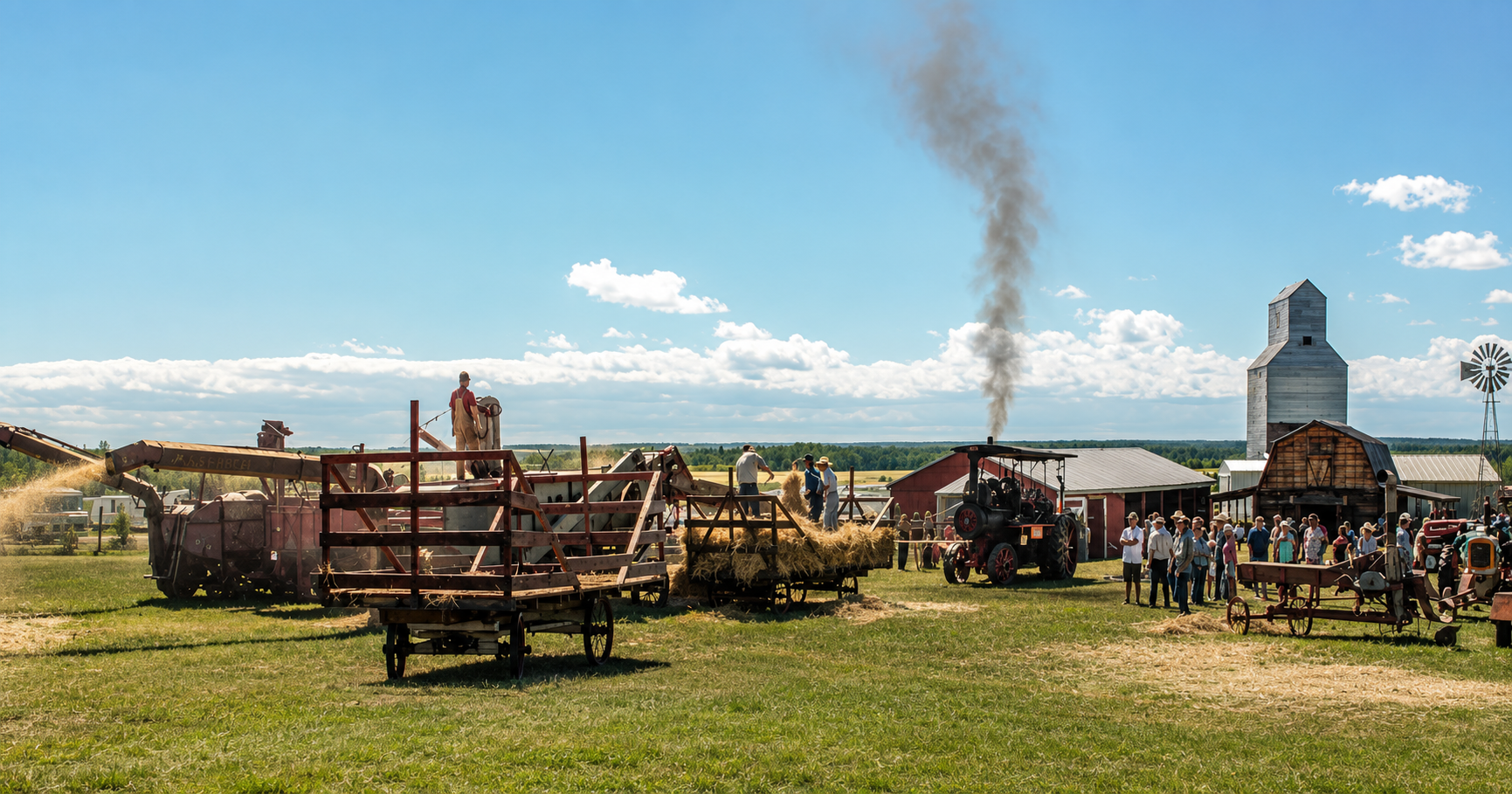
The South Peace Centennial Museum, located on Highway 43 between Beaverlodge and Hythe, stands as one of Alberta’s premier agricultural heritage sites. It began modestly in 1967 as a hobby of local enthusiast Ted McLean, who collected and restored old farm machinery, particularly steam engines. That year—Canada’s Centennial—saw the first “Pioneer Day” event, featuring threshing demonstrations, sawmill operations, homemade ice cream, flour grinding, and vintage tractor displays, drawing community support.
What started as a small collection has grown into a 40-acre pioneer village and interpretive centre, recognized as the largest working, steam-powered farm equipment museum in Alberta. It features hundreds of restored antique tractors, steam engines, stationary engines, horse-drawn wagons, carriages, and automobiles. Visitors explore 15+ historic buildings moved to the site, including homesteaders’ cabins, a trading post, church, school (such as Two Rivers School), grist mill, community hall (Circle Bank Hall), general store, blacksmith shop, barn, carriage house, and railway structures. A notable addition is the Foster’s Pioneer Grain Elevator complex, relocated in a major project around 2004.
The museum emphasizes hands-on experiences of pre-modern pioneer life, highlighting the ingenuity required to build the region without electricity or advanced machinery. Annual events like Pioneer Days (featuring working equipment, antique vehicles, and entertainment), Harvest Festival, car shows, farmers’ markets, and seasonal activities draw visitors year-round. Open daily in summer by donation, it continues its mission: “Preserve the Past ~ For the Future.”
Beaverlodge Art & Culture Centre
Housed in the historic former Beaverlodge Hospital (built in 1937, operated until 1956), the Beaverlodge Art & Culture Centre (also known as the Beaverlodge Area Cultural Society or BACS) represents the town’s transformation of a practical medical building into a vibrant community arts hub.
The centre features multiple galleries for rotating exhibits, a gift shop highlighting local artists and craftspeople, artists’ studios, workspaces for potters and weavers, and a charming Pink Tea Room (formerly the men’s ward) with stained glass. It includes the McNaught Room, dedicated to the legacy of Euphemia McNaught. The facility hosts art classes, workshops, monthly shows, and community events, serving as a gathering place that bridges the area’s pioneer history with contemporary creativity.
Its location across from Beaverlodge’s iconic giant beaver statue makes it a visible landmark along the Alaska Highway route, drawing locals and travelers alike.
Euphemia McNaught Homestead Heritage Site
The McNaught Homestead, located south of Beaverlodge on secondary highway 722, is a Provincial Historic Resource designated in 2003. It exemplifies early 20th-century settlement in the Peace River Country and is deeply tied to one of Alberta’s most acclaimed artists.
In 1909–1911, groups of settlers from Ontario, including members of the Christian Association, arrived in the Beaverlodge area. Charles and Eliza McNaught homesteaded starting in 1911, building a two-storey log house and other structures. Their daughter Euphemia (“Betty”) McNaught (1902–2001) arrived with the family in 1912. She trained at the Ontario College of Art (graduating 1929) under Group of Seven members J.E.H. MacDonald and Arthur Lismer, then returned to the homestead. She established a studio in the relocated Appleton schoolhouse on the property and became renowned for her vivid depictions of northwestern Canadian landscapes. Her work earned provincial and national recognition, including awards like the Alberta Achievement Award (1977) and the Sir Frederick Haultain Award (1982).
The site comprises about 17 buildings on roughly 64 hectares, including the original log house (stucco-covered), large and small barns, chicken coop, pump house, garage, granaries, and the schoolhouse—forming one of the most complete early settlement farmsteads in the region. Donated by Noel McNaught to the Art Gallery of Grande Prairie, it is now stewarded by the McNaught Homestead Preservation Society (formed 2005). The Society focuses on restoration, an artists’ retreat, festivals, workshops, nature trails, and preserving the legacy of Euphemia McNaught as an educator and advocate for the arts.
Interconnected Heritage
These sites are intertwined: the Beaverlodge Art & Culture Centre honours McNaught’s contributions, while the South Peace Centennial Museum preserves the broader pioneer agricultural context that shaped her world. Together, they celebrate the hardworking settlers who tamed the Peace Country, the cultural life that flourished there, and the enduring artistic inspiration drawn from its landscapes. Visitors to the Beaverlodge area can experience living history—from steam-powered demonstrations and pioneer buildings to galleries and the serene homestead that nurtured a major Canadian artist. These institutions keep the region’s stories alive for future generations.