
News
September 23, 2026 – Regular Council Meeting

Please join Council during their Regular Council meeting on September 23rd @ 9:00 AM, either in person at the MD Administration Office or virtually on Teams.
Meeting ID: 265 752 763 517 63
Passcode: WD2yp3CR
For access to the agenda, click on September 23, 2026 Agenda.
Why Rail Safety Week 2026 Matters More Than Ever
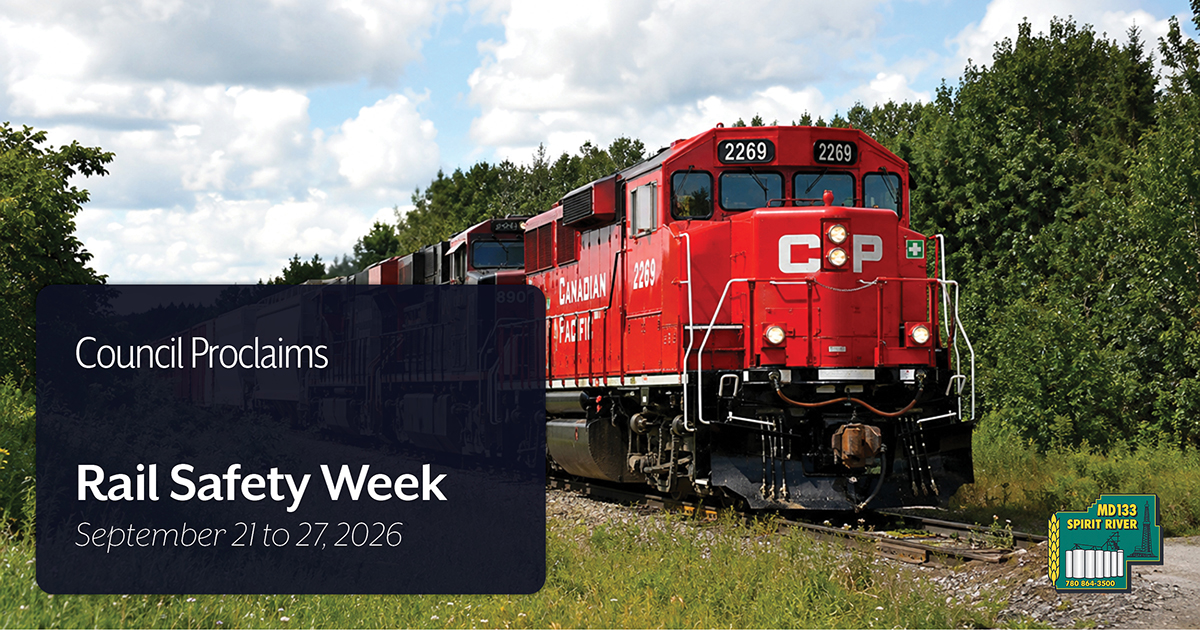
The Municipal District of Spirit River No.133 has proclaimed September 21 – 27, 2026, as Rail Safety Week.
Stay Off the Tracks: Why Rail Safety Week 2026 Matters More Than Ever
Every year, trains move millions of tonnes of goods and thousands of passengers across Canada. They are a backbone of our economy and a familiar part of the landscape. Yet for too many people, that familiarity breeds a dangerous complacency.
From September 21 to 27, 2026, communities across the country will mark Rail Safety Week. The campaign arrives with sobering numbers: in 2025 alone, Canada recorded 252 railway crossing and trespassing incidents. Those events left 69 people dead and another 60 with serious injuries—lives cut short or forever changed by incidents that were almost entirely avoidable.
The message is straightforward but urgent. Railway rights-of-way are private property. Crossing tracks outside designated areas, walking along the rails, or ignoring signals and barriers is not a shortcut or a thrill—it is a high-stakes gamble. Trains cannot stop quickly. A freight train travelling at speed can take more than a kilometre to come to a halt. Pedestrians and drivers who assume they can beat the train, or who simply fail to look and listen, pay the highest price.
Education remains one of the most effective tools we have. Operation Lifesaver, a long-standing public-private partnership, works with railways, governments, police, media, and community groups to drive that message home. Their focus is practical: remind people that tracks are not public paths, heighten awareness at highway-rail grade crossings, reinforce the habit of looking and listening near railways, and stress the importance of obeying traffic laws. CN and Operation Lifesaver have asked municipalities across Canada to formally support these efforts. When local councils adopt resolutions endorsing Rail Safety Week, they help turn national statistics into local conversations—conversations that can prevent the next tragedy.
Rail Safety Week is not about fear. It is about respect. Respect for the power and speed of trains, respect for the private property they travel on, and respect for the simple rules that keep people alive. Whether you drive, walk, cycle, or simply live near a rail line, the habits are the same: stop, look, listen, and never take a chance.
This September, take a moment to talk with family, friends, and neighbours—especially younger people who may not fully grasp the danger. Share the facts. Support the campaigns. And when you approach a crossing or see tracks nearby, treat them with the seriousness they deserve.
Because every avoidable fatality and injury is one too many. And every life saved starts with awareness.
Property Assessor in the Area

Our friendly property assessor will be in our area starting sometime next week (the week of September 20, 2026) to complete routine property assessments.
If you have any questions or concerns, please call the Assessor’s Office at Northern Sunrise County at (780)624-0013.
Thanks for your cooperation.
Honouring Firefighters’ National Memorial Day
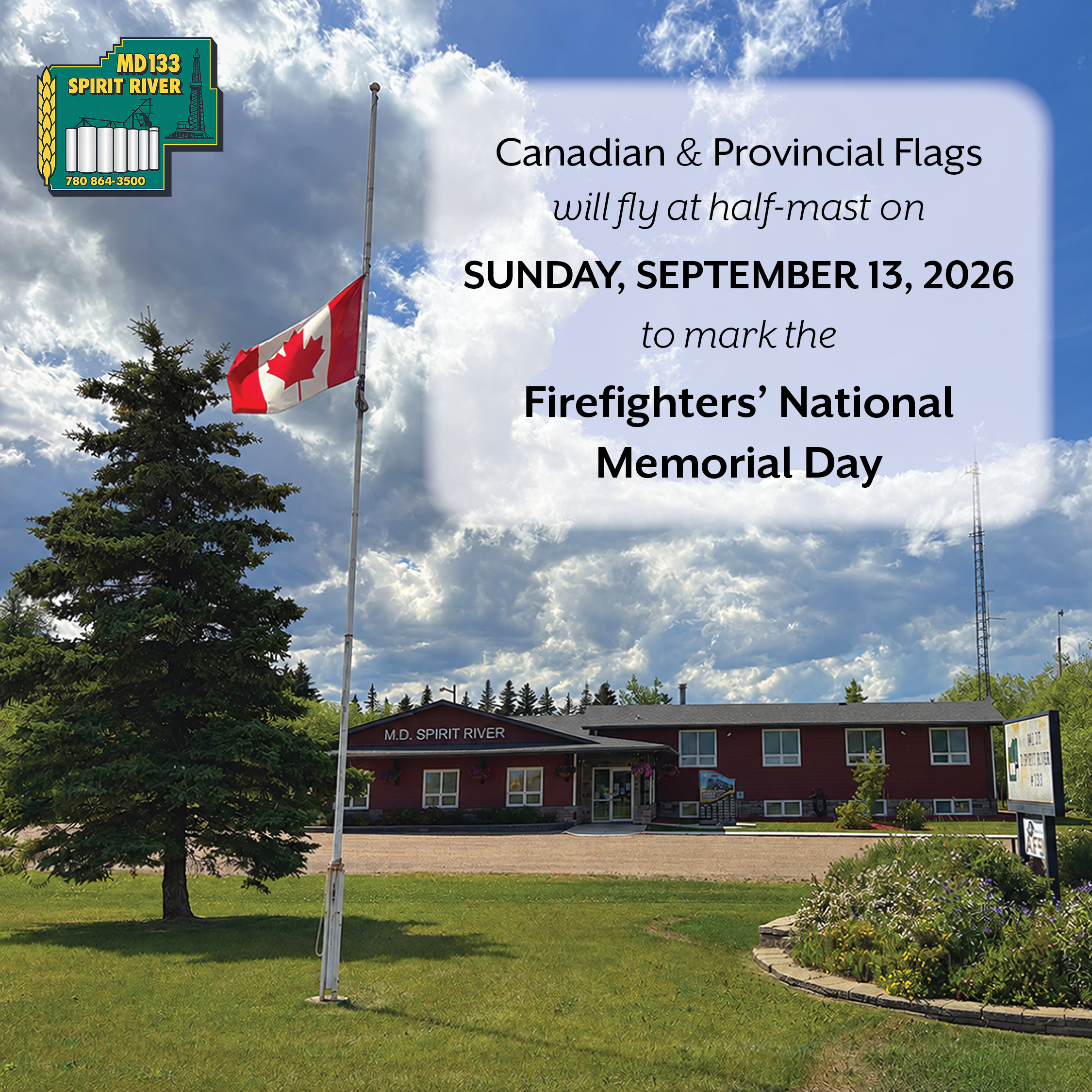
Firefighters’ National Memorial Day is observed annually in Canada on the second Sunday in September. It is a national day of remembrance dedicated to honouring the courage, selflessness, and ultimate sacrifices of Canadian firefighters who have died in the line of duty.
History
The day received its formal designation in 2017. On August 25th of that year, then-Public Safety Minister Ralph Goodale announced its establishment in Regina, Saskatchewan. A subsequent proclamation by the Governor General formally declared the second Sunday in September each year as Firefighters’ National Memorial Day. The first observance took place on September 10, 2017.
This official recognition built on earlier efforts by the Canadian Fallen Firefighters Foundation (CFFF). The Foundation had been holding annual memorial ceremonies for more than a decade, often timed near September 11 in recognition of the broader significance of that date for emergency responders. The Foundation’s long-standing work also led to the creation of the Canadian Firefighters Memorial in Ottawa’s LeBreton Flats (the site of the Great Ottawa Fire of 1900). Designed by artist Douglas Coupland and landscape architect Mary Tremain, the monument was dedicated in 2012. It features a tall fire pole, a bronze firefighter statue cast from recycled brass couplings donated by fire stations across the country, and a granite memorial wall engraved with the names of fallen firefighters, mapped according to the province or territory they served.
Records of line-of-duty deaths date back to 1848. According to the CFFF, more than 1,300 Canadian firefighters had died in the line of duty by the time the national day was established; the total has continued to grow as new names are added each year during the annual ceremony in Ottawa.
Importance
The day serves as a national acknowledgment of the inherent dangers of firefighting and the profound personal cost borne by firefighters and their families. On this day, the Canadian flag is flown at half-mast on all federal buildings and establishments, including the Peace Tower, from sunrise to sunset. Memorial ceremonies take place across the country, with the main national event hosted by the CFFF at the Ottawa memorial. Families of the fallen are supported through programs such as the Memorial Grant Program for First Responders.
Beyond formal remembrance, the day highlights the ongoing service of Canada’s approximately 200,000 firefighters—career, volunteer, wildland, military, airport, and industrial—who protect communities from fires, medical emergencies, hazardous materials incidents, and increasingly severe wildfires linked to climate change. It underscores public gratitude for their readiness to place themselves in harm’s way and reinforces the importance of supporting both serving firefighters and the families of those who have made the ultimate sacrifice.
In short, Firefighters’ National Memorial Day ensures that the names and legacies of those who answered their last alarm are never forgotten, while affirming the vital role firefighters play in the safety and resilience of Canadian communities.
Discover the story behind the Canadian Firefighters Memorial in LeBreton Flats in this Decoding ART video.
Transit Bus Unavailable from September 15-17
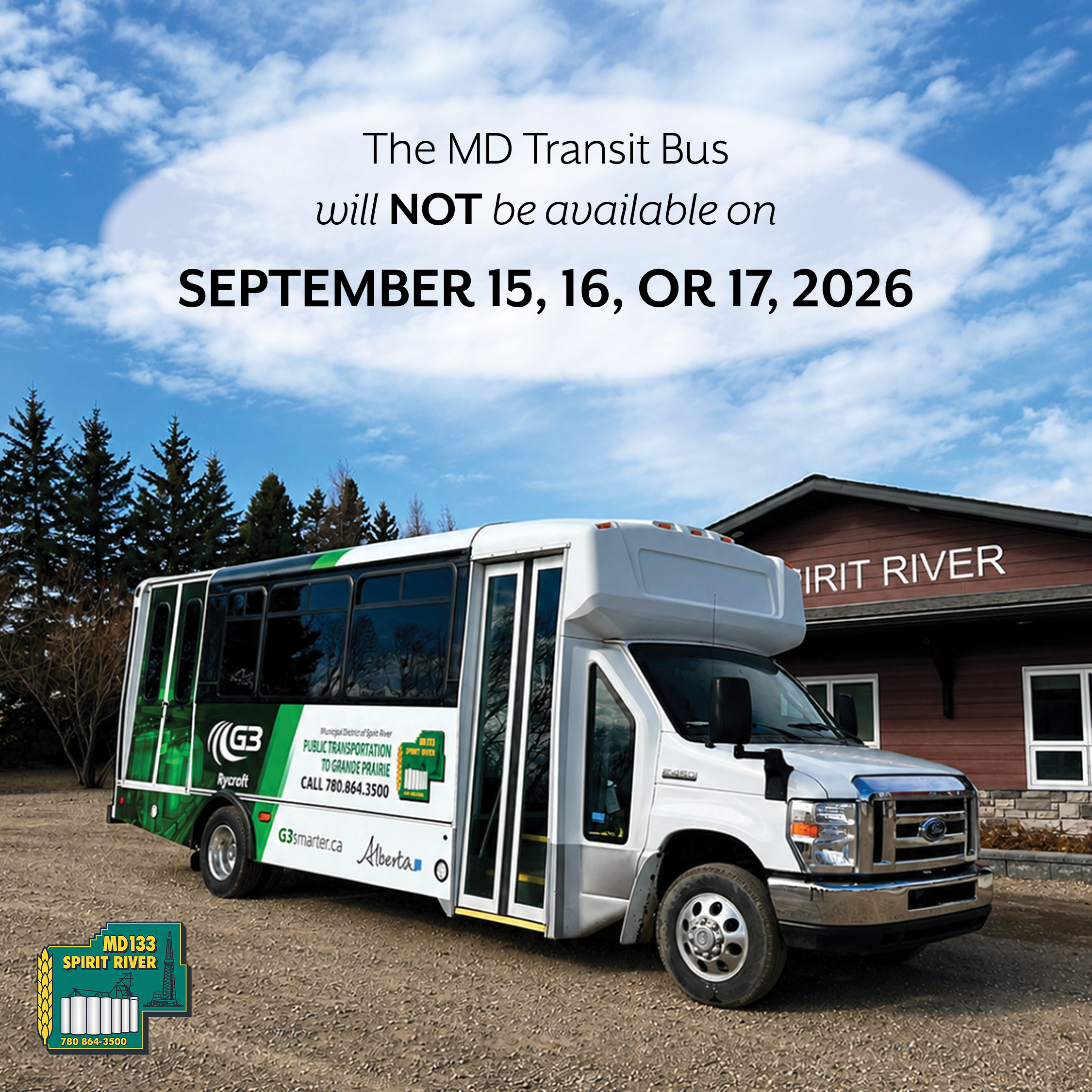
The MD Transit Bus will be unavailable for public service on September 15, 16, & 17, 2026.
September 9, 2026 – Regular Council Meeting

Please join Council during their Regular Council meeting on September 9th @ 9:00 AM, either in person at the MD Administration Office or virtually on Teams.
Meeting ID: 220 505 280 799 48
Passcode: wi3tD3hB
For access to the agenda, click on September 9, 2026 Agenda.
Congratulations Bursary Recipients
Congratulations to Our 2026 Bursary Recipients!
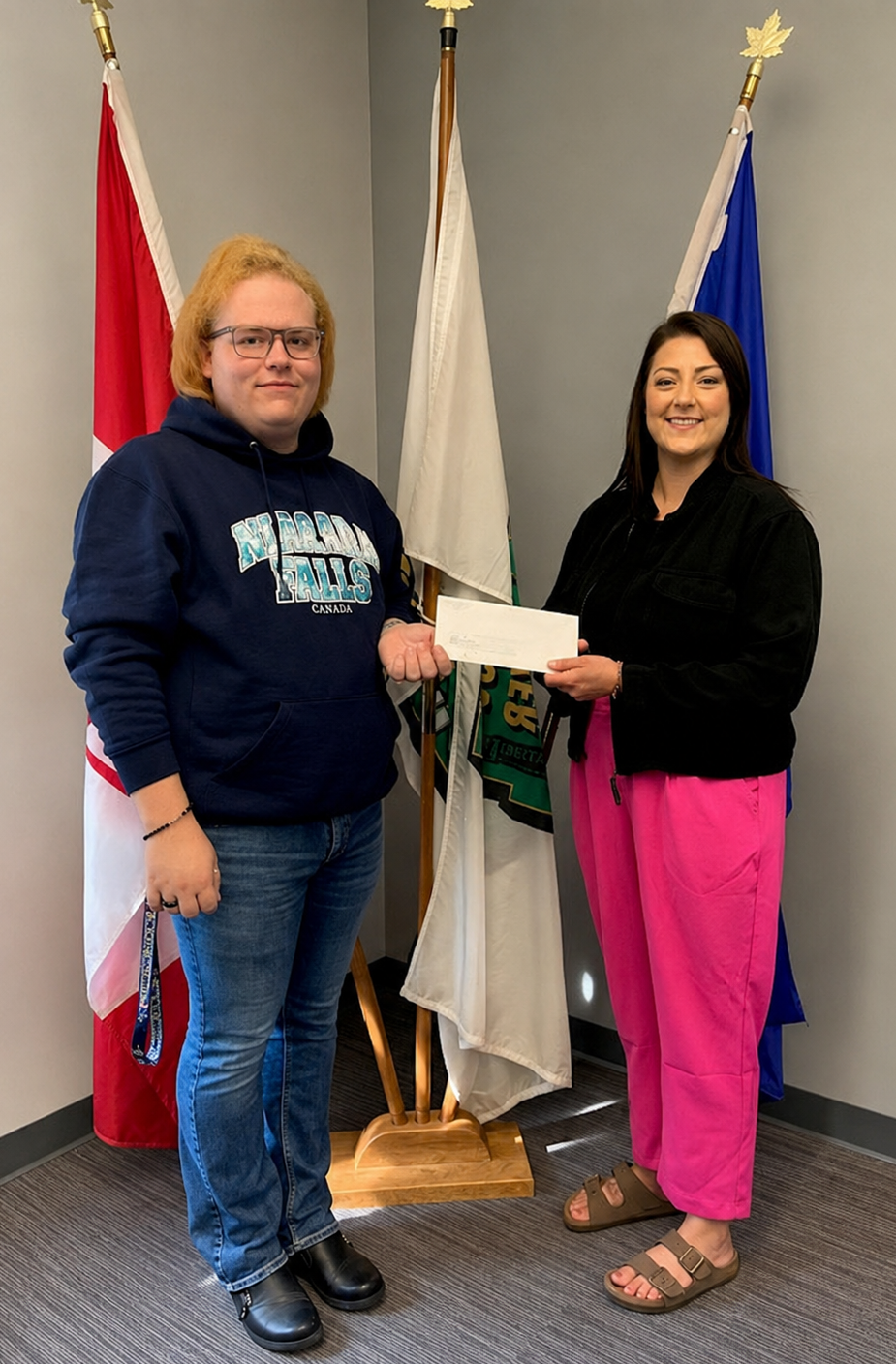
The Municipal District of Spirit River #133 is pleased to congratulate Colton Witts, Shaelyn Beaupre, and Tyler Tomkow on being selected as this year’s recipients of the $1,000 MD of Spirit River #133 Bursary.
This bursary program recognizes local students who demonstrate leadership, community involvement, and a commitment to making a positive difference. By supporting students as they pursue their post-secondary goals, the MD is proud to invest in the future of our communities and Northern Alberta.
Congratulations, Colton, Shaelyn, and Tyler!
We wish each of you every success as you continue your education and pursue your goals. We look forward to seeing where your hard work, leadership, and commitment take you!
Your future is bright—and your community is proud to support you along the way.


Back to School Safety

Slow Down, Stay Alert and Watch for Kids
School is back, and that means more children are walking, cycling, and riding buses on our roads. As families settle back into their school routines, drivers are reminded to take extra care around school zones, crosswalks and bus stops.
Children may be excited, distracted or unpredictable as they make their way to and from school. With darker mornings and busy afternoons becoming part of the daily routine, a few extra seconds of caution can make a big difference.
Drivers: Slow Down and Stay Alert
When travelling through school zones and areas where children may be present:
- Watch carefully for children crossing the road, including those who may suddenly step into traffic.
- Avoid distractions and scan the road carefully for children walking or cycling.
- Turn on your headlights during low-light hours to improve visibility and help others see you.
- Monitor crosswalks and school zones carefully, particularly during the busy morning and afternoon periods.
- Remember that you are not permitted to pass or attempt to pass another vehicle travelling in the same direction within a school zone while the zone is in effect.
- The school-zone speed limit is 30 km/h in both urban and rural areas unless otherwise posted.
Know the School Bus Lights
School buses make frequent stops to pick up and drop off children, so knowing what their lights mean is essential.
Flashing amber lights: These indicate that the school bus is slowing down and preparing to stop so children can get on or off.
Flashing red lights: Drivers must stop when a school bus activates its flashing red lights, whether approaching the bus from the front or following behind.
The only exception is when the school bus is on the opposite side of a divided highway.
Once stopped, remain stopped until the red lights stop flashing. Before proceeding, continue watching carefully for children who may still be crossing or moving around the bus.
A Few Important Facts
- The vast majority—about 90 percent—of collisions involving school buses occur in urban areas.
- Failing to stop for a school bus displaying flashing red lights carries a $567 fine and six demerit points.
Safety Is Everyone’s Responsibility
Drivers aren’t the only ones who can help keep children safe. Parents, guardians and educators can reinforce good habits by regularly reviewing road-safety rules with children throughout the school year.
Talk about looking both ways before crossing, paying attention around roads and driveways, and staying alert rather than assuming that drivers have seen them.
As the school year gets underway, let’s all do our part to make the roads safer for our youngest community members.
Slow down. Put the phone away. Watch for kids. And give school buses the space and respect they need.
A few extra seconds of attention can help ensure every child gets home safely.
Notice of Development Permit Approval 12-DP-26
Discover Tumbler Ridge’s History and Wonders
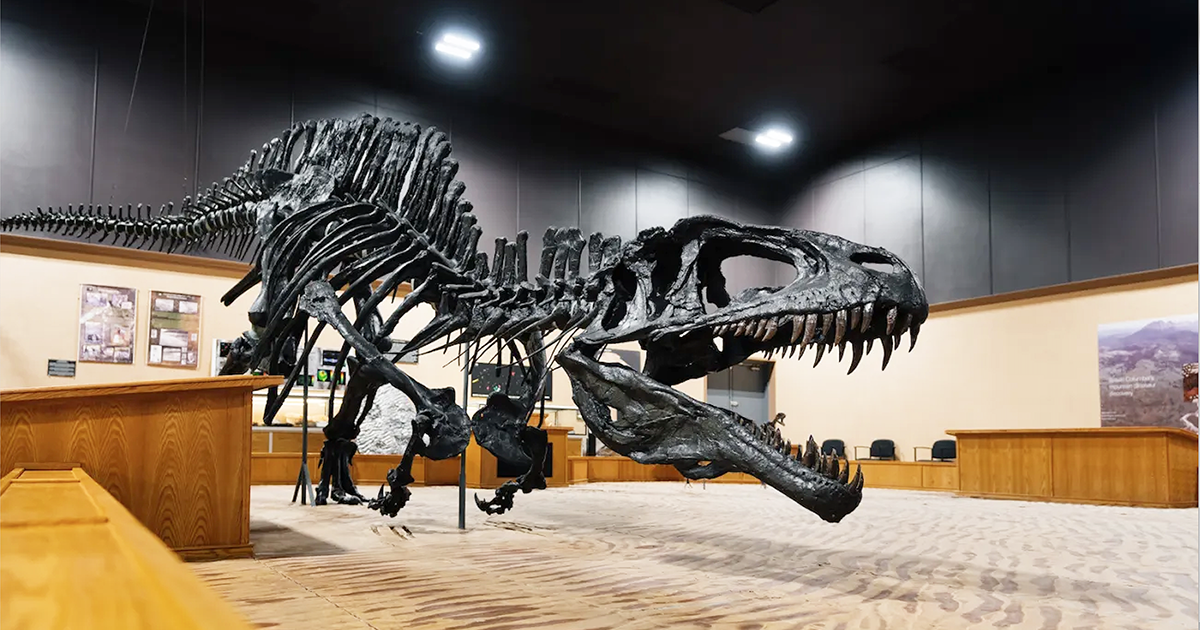
Nestled in the foothills of the Rocky Mountains in northeastern British Columbia, Tumbler Ridge is a place where deep time, resilient community spirit, and spectacular natural beauty come together. This year’s last MD Summer Bus Tour heads there on Friday, August 28—your final chance this season to experience one of the Peace Country’s most rewarding destinations. Seats are limited, so book soon and join us for a day that blends fascinating history with must-see attractions.
From Ancient Footprints to Instant Town
People have lived in and moved through this landscape for thousands of years. Archaeological evidence points to human presence dating back at least 3,000 years, with the nomadic Sekani, followed by the Dane-zaa and Cree, using the area for temporary settlements and travel. European exploration came later: formal expeditions in the early 20th century mapped the rugged terrain, and the name “Tumbler Ridge” itself comes from a ridge marked by rockslides, adapted by geologist Edmund Spieker from earlier maps.
Permanent settlement began sparingly in the 1920s. Kate Edwards, a determined widow, established a ranch in the Wolverine Valley in 1921 and drove cattle long distances to market. In the 1930s, local promoter Alex Monkman championed a highway through the low Monkman Pass to connect Peace River grain farmers to markets—an ambitious dream that left a lasting mark on the region’s trails and stories.
Everything changed with coal. Large deposits were identified in the mid-20th century. After the 1970s energy crises, a major agreement in 1981 between Canadian mining companies (including Denison and Teck), a consortium of Japanese steel mills, and the governments of British Columbia and Canada launched the Northeast Coal Development. Tumbler Ridge was created from scratch as a planned “instant town” to house workers for the Quintette and Bullmoose mines. Incorporated as a district municipality in 1981, the community, infrastructure, and mines rose rapidly; the first residents arrived in the early 1980s. It was designed with livability in mind, aiming to avoid the pitfalls of traditional company towns.
The mines supplied metallurgical coal for years, but the community faced hard times when Quintette closed in 2000 and Bullmoose in 2003. Rather than fade, Tumbler Ridge diversified—embracing forestry, energy, outdoor recreation, and especially tourism. Coal mining has seen revivals at times, yet the town’s true renaissance came from an unexpected source: dinosaurs.
In 2000, two local boys discovered dinosaur trackways along Flatbed Creek. That find triggered a cascade of discoveries—ankylosaur tracks, rare tyrannosaur trackways (including evidence that these predators may have moved in groups), bonebeds, and more. Today the area holds some of British Columbia’s most significant paleontological resources, spanning marine life from when the region was underwater, dinosaur footprints and bones, plant fossils, and Ice Age mammals.
The Tumbler Ridge UNESCO Global Geopark
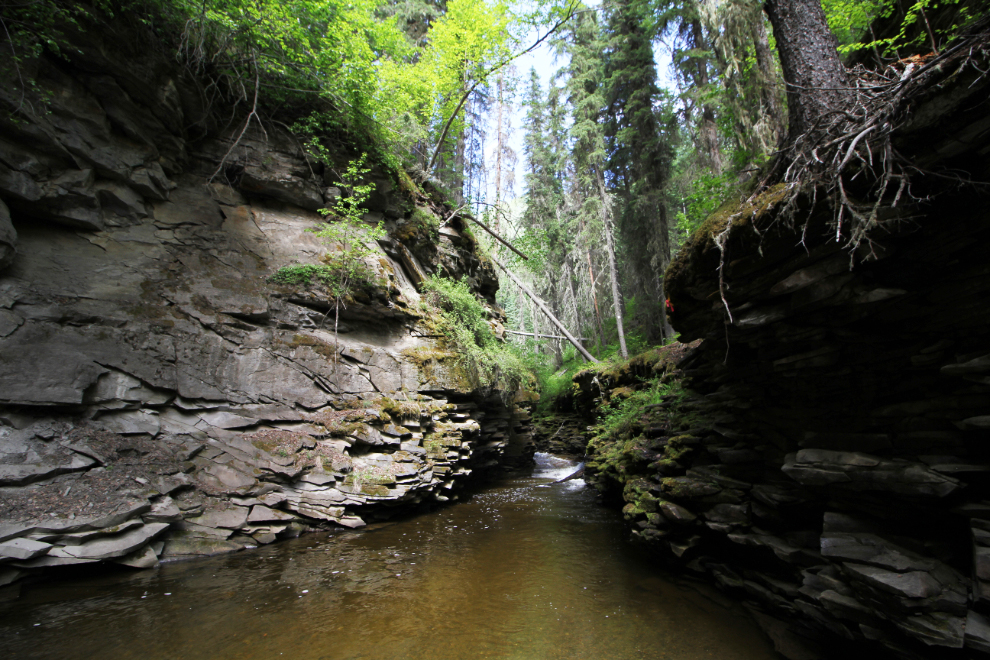
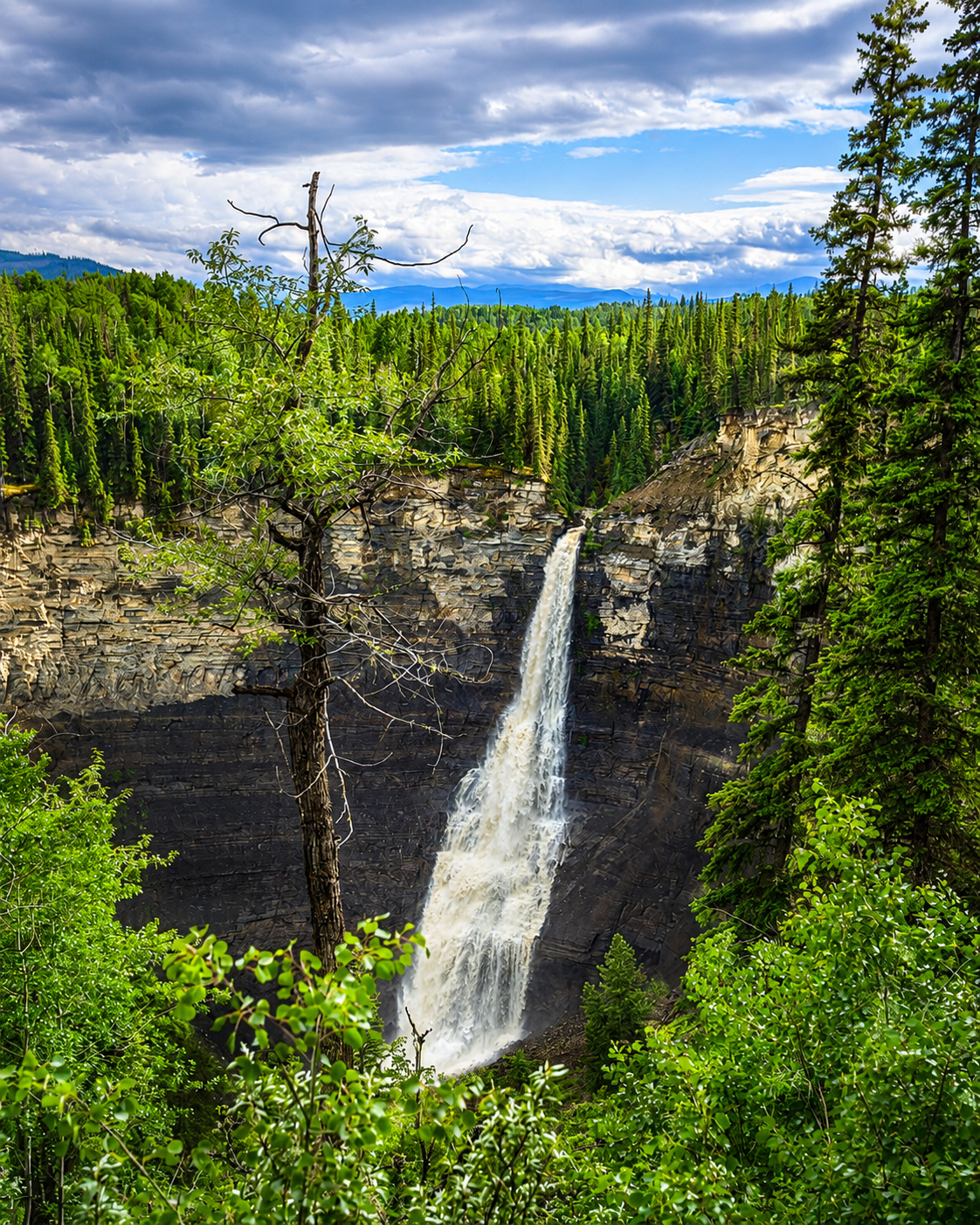
In 2014 (with formal recognition following), the region earned designation as a UNESCO Global Geopark—one of only five in Canada and the only one in western North America. Covering roughly 8,478 square kilometres, it showcases outstanding geology: ancient mountain-building, glacial shaping, waterfalls, canyons, caves, alpine meadows, and world-class dinosaur trackways.
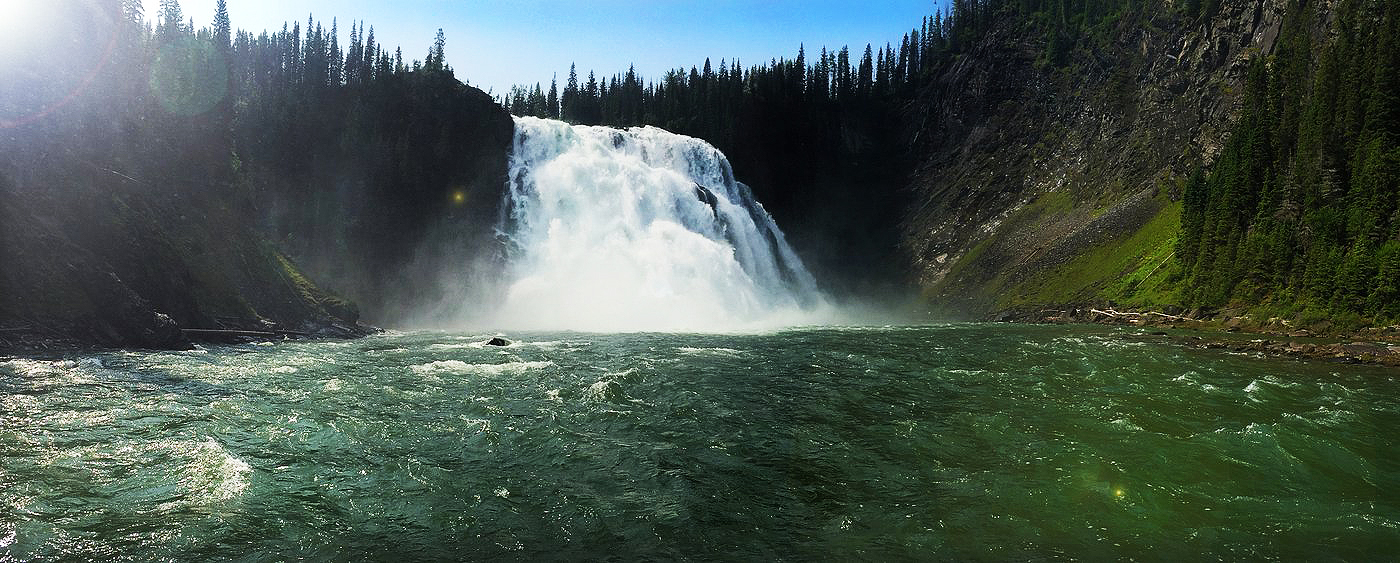
Highlights include Kinuseo Falls in nearby Monkman Provincial Park (taller than Niagara Falls and a dramatic centrepiece), the Flatbed Valley geosites with accessible trackways, the Shipyard and Titanic rock formations, Bergeron Falls, and numerous hiking trails. Unlike strict national or provincial parks, a Geopark celebrates geological heritage while remaining open to compatible activities and community life. It is a living landscape of discovery—perfect for walking in the footsteps of dinosaurs, chasing waterfalls, or simply soaking in the foothills scenery.
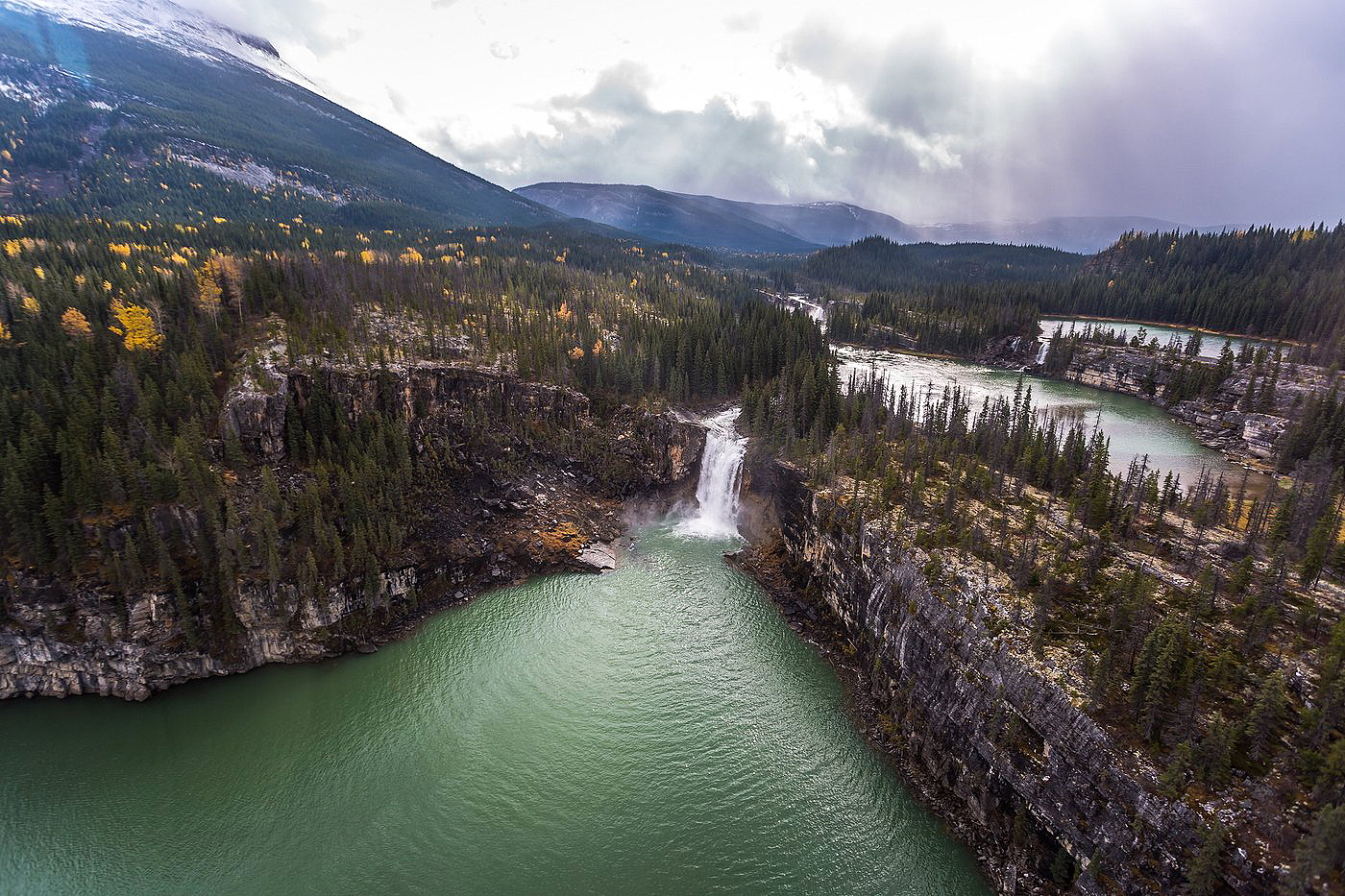
Tumbler Ridge Museum and Dinosaur Discovery Gallery
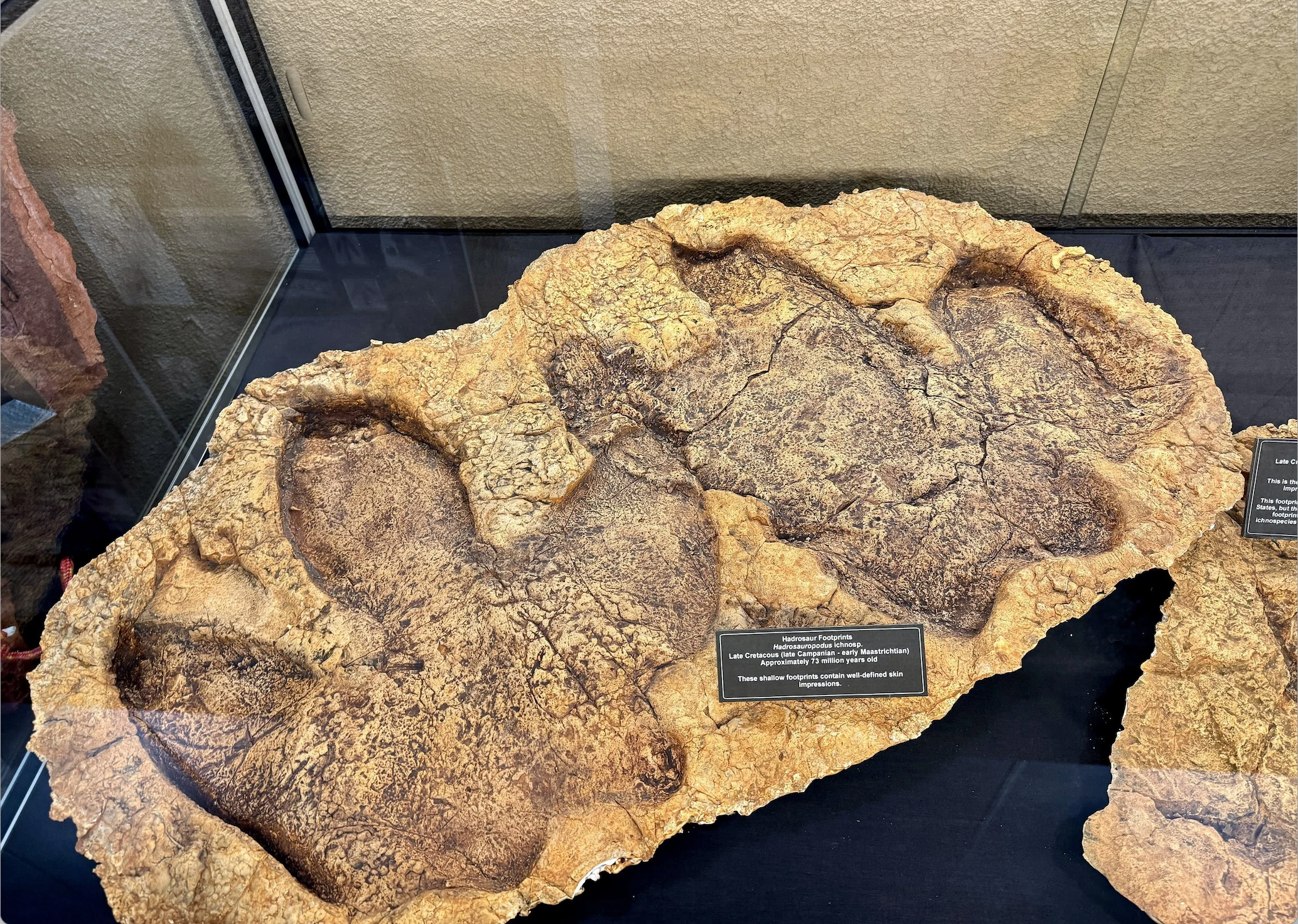
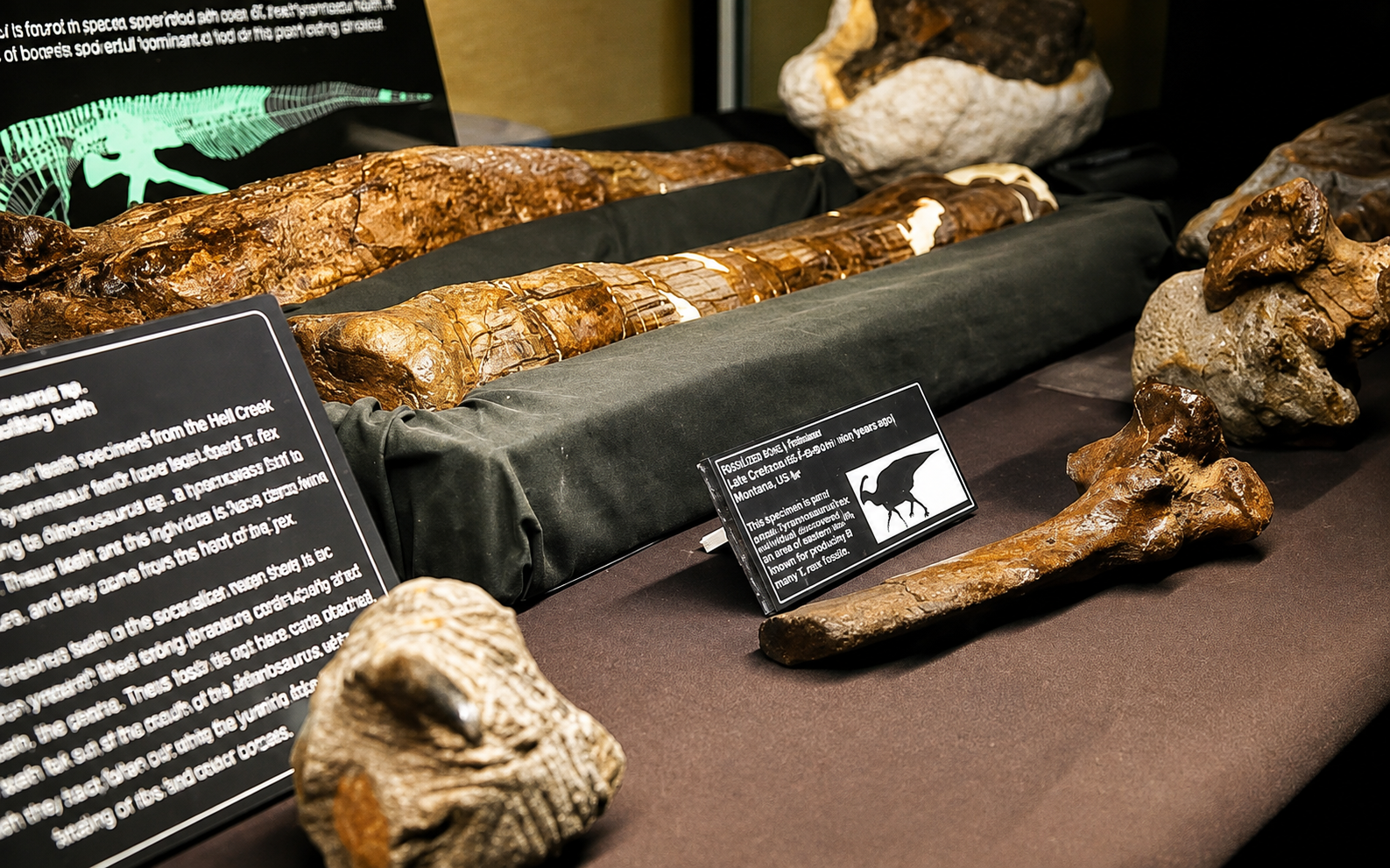
The Tumbler Ridge Museum Foundation grew directly out of those 2000 trackway finds. Its Dinosaur Discovery Gallery (and associated research centre) displays an impressive collection spanning more than 200 million years: marine reptiles and fish from the Triassic, dinosaur footprints and bones, plant fossils, and Ice Age mammals. You’ll see rare tyrannosaur tracks, local specimens unavailable elsewhere, and stories of both scientific research and citizen discoveries.
Guided trackway tours (typically offered in summer) take visitors to sites such as Cabin Pool/Flatbed Creek, where dozens of prints from multiple dinosaur types are visible in the bedrock. The museum also preserves human history and partners closely with the Geopark. It’s an essential stop for understanding why this remote corner of BC has become a paleontology hotspot.
The Community Centre: Heart of Town
The Tumbler Ridge Community Centre serves as a welcoming hub for visitors and residents alike. It features a full aquatic centre (pool, tots pool, sauna, hot tub, steam room), fitness facilities, squash/racquetball courts, ice arena, curling rink, indoor playground, public library, art gallery showcasing local work and scenic photography, and a Sports Hall of Fame. Historical displays and the human-history side of the museum story are also found here, offering context on pioneers, the Monkman Pass era, coal-mining beginnings, and early dinosaur finds. It’s a great place to stretch, learn a little more, or simply enjoy the friendly atmosphere of this resilient community.
Why This Trip Matters—and Why You Should Book Now
Tumbler Ridge is no longer just a former mining town. It is a UNESCO Global Geopark destination where ancient Earth history meets modern outdoor adventure and warm small-town hospitality. On our bus tour, you’ll enjoy the scenic ride into the foothills, time at the Geopark highlights, the Museum’s extraordinary fossils and trackways, and the amenities of the Community Centre—all in the company of fellow travellers on the final MD Summer Bus Tour of 2026.
Friday, August 28 is the last summer departure. Don’t miss this opportunity to explore a place that was built in a few short years, nearly lost its economic heart, and reinvented itself around dinosaurs, waterfalls, and wild beauty. Book your seat today and experience Tumbler Ridge for yourself—history, wonder, and a memorable day trip await.
To save a spot on the bus, call the office at (780) 864-3500.
Bus Fare: Age 16+ $25.00; Under 16 $5.00
Fare is due upon registration. Riders are responsible for all expenses over and above the bus fare.
The bus leaves the MD garage at 8:30 AM to pick up passengers at designated locations and will return between 3:30 PM and 4:00 PM.
Priority given to seniors and people with limited mobility.